Buying a business is an attractive route into entrepreneurship for many people in Switzerland. Instead of building a new venture, buyers take over an existing structure with customers, employees, processes and market position. This approach is particularly relevant because numerous SMEs in Switzerland are facing succession planning.
Anyone who wants to buy a business, however, faces several challenges. The market is not very transparent, many successions are handled discreetly, and the quality of the opportunities varies widely. This makes a structured approach with clear criteria and a realistic understanding of the process all the more important.
This guide shows how a business acquisition in Switzerland works, which types of buyers there are, which steps are necessary and what matters in valuation, due diligence and financing.
Why buy a business in Switzerland instead of founding one?
For many aspiring entrepreneurs, founding a company is the classic first thought. In practice, however, buying an existing business is often the more direct, more predictable and lower-risk route. Anyone who wants to buy a business takes over not just an idea, but a functioning structure.
An existing SME usually already comes with several decisive advantages:
- Customer base: The market is there; initial revenues do not have to be painstakingly built up first.
- Proven business model: The company has already proven itself in day-to-day operations.
- Employees and know-how: Knowledge, relationships and workflows are already in the company.
- Processes and infrastructure: Many operational foundations already exist.
- Market positioning: Brand, network and supplier relationships are often established.
In Switzerland in particular, this approach is especially relevant. The SME sector is diverse, stable and highly specialised in many industries. At the same time, numerous companies will be facing succession planning in the coming years. This creates an environment in which buyers can find attractive opportunities. Provided they proceed strategically and with discipline.
The guiding principle of buying a business instead of founding one is therefore gaining in importance. Especially for people who want to become entrepreneurs but do not want to start from zero, a business acquisition is a convincing alternative. Why this decision pays off in practice is shown in our article on business acquisition in Switzerland.
What types of buyers are there?
Not every buyer pursues the same goal. Anyone who wants to buy a business in Switzerland brings different expectations, strengths and circumstances depending on their background. This starting position also influences which companies come into question and how the search process should be designed.
Entrepreneurial individual buyers
These are people who want to take over and continue running a company operationally themselves. They are often ambitious specialists or executives planning the step into self-employment. For them, the focus is usually not on the capital investment but on active entrepreneurial responsibility.
ETA candidates
ETA stands for Entrepreneurship Through Acquisition. It refers to the route into entrepreneurship via the purchase of an existing company rather than via a new start-up. This model is becoming increasingly relevant in Switzerland too. ETA candidates look specifically for companies with development potential that they want to lead themselves and expand over the long term.
Management buy-in buyers
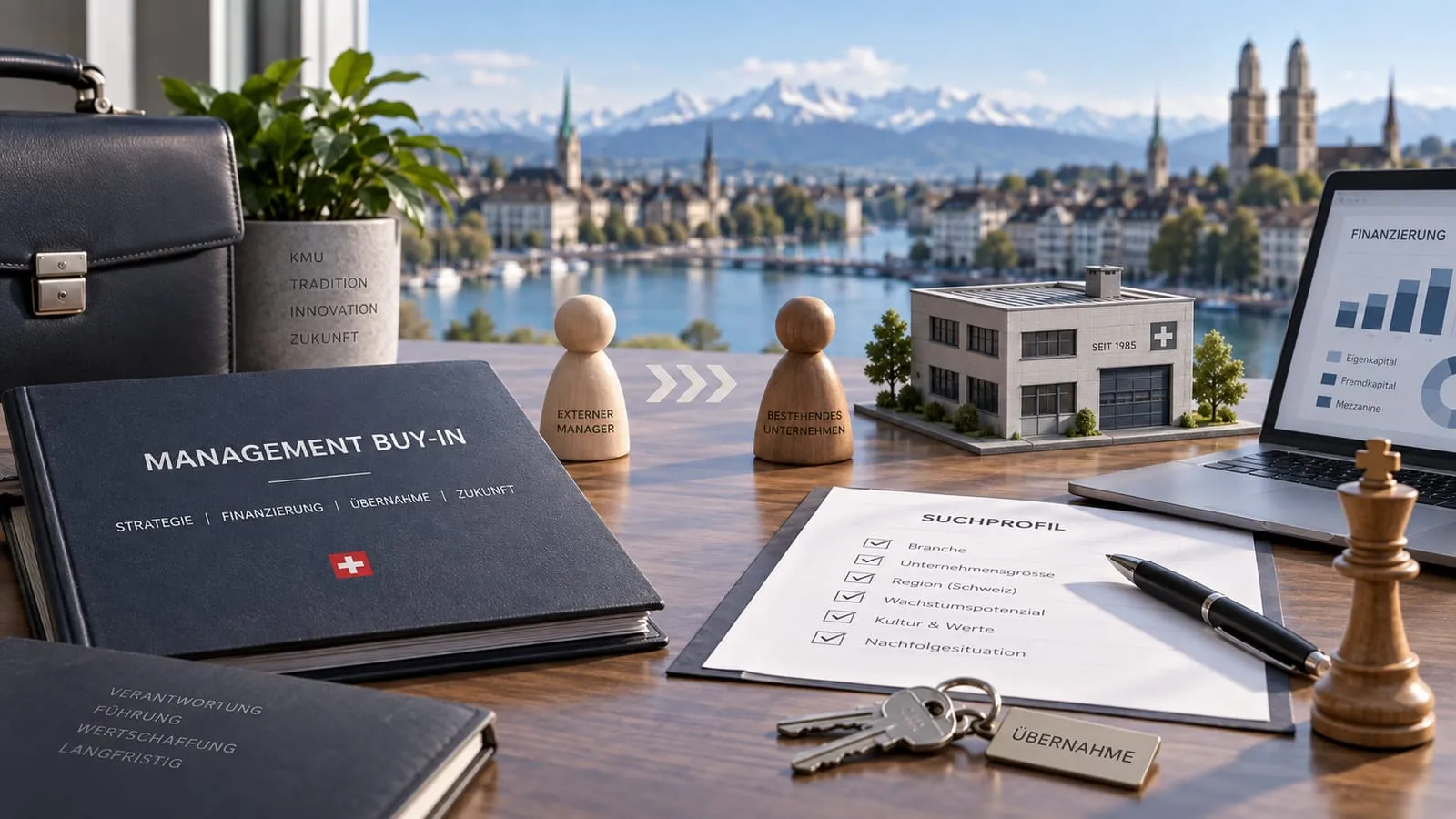
In a management buy-in, an external executive takes over a company. These buyers often bring operational experience, industry understanding or leadership skills and see the takeover as the next career step. In the Swiss SME market in particular, this is a realistic model when sellers cannot find an internal successor.
Investors and search funds
Some buyers pursue a business acquisition primarily as an investment strategy. These include private investors, private equity firms or search funds. With search funds, investors provide capital so that a search fund manager can look specifically for a suitable acquisition target. After a successful purchase, the company is often actively supported and developed further.
Strategic buyers
These are usually existing companies that want to acquire other firms in order to expand their business. This can be for reasons of market expansion, succession, capacity, technology or customer base. Strategic buyers often think more strongly in terms of synergies than purely entrepreneurial individual buyers.
For getting started operationally, it is important to define your own role clearly. Who am I as a buyer? What responsibility do I want to take on? How actively do I want to lead the company? And what financial resources or partners do I bring with me? These questions form the basis for the further search.
The first steps in a business acquisition in Switzerland
Anyone who wants to buy a business should not start with the first opportunity that comes along, but with structured preparation. In the Swiss market in particular, the quality of the first steps often determines whether the later process runs efficiently or laboriously.
1. Define goals and search profile
It starts with strategic clarification. Buyers should ask themselves:
- Which industry comes into question?
- Do I want to be operationally active or rather invest?
- Which company size suits me?
- In which region am I searching?
- What role do I want to take on in the company?
- What financial resources are available?
These considerations result in a realistic search profile. Anyone who starts without a clear goal quickly gets lost in unsuitable opportunities.
2. Set acquisition criteria
In addition to the general search profile, concrete criteria are needed. These include, for example:
- Revenue and earnings size
- Number of employees
- Location
- Industry focus
- Customer structure
- Investment requirements
- Reason for succession
- Scaling potential
These criteria help to filter offers and set priorities. At the same time, they later serve as the basis for assessing possible target companies. You will find a complete step-by-step overview in our business acquisition checklist for Switzerland.
What makes Swiss SME acquisitions special
Buying a business in Switzerland often means searching actively. Good companies are not always publicly listed on the classic platforms. That is why different channels are needed:
- personal networks
- fiduciaries and advisors
- M&A intermediaries
- succession platforms
- direct outreach to target companies
- industry contacts
In the SME environment in particular, many opportunities arise discreetly and outside broad public listings. A structured search is therefore key. How targeted direct outreach works in practice is shown in our article Finding companies outside of platforms. Just as key is a realistic view of financing. Anyone who only clarifies these questions late in the process loses time and credibility. An early financing logic creates clarity and strengthens your position vis-à-vis sellers.
The practical process of a business acquisition in Switzerland
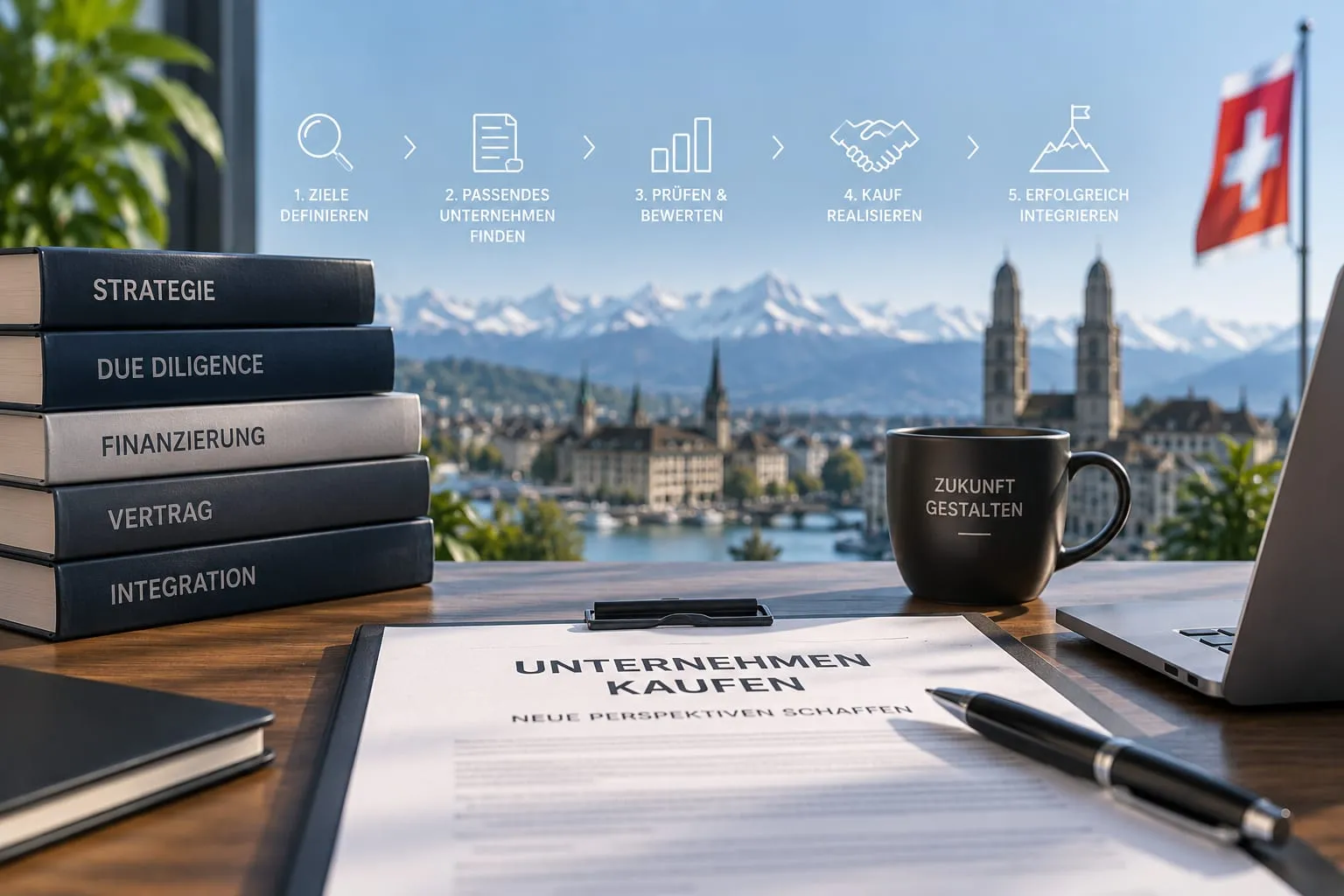
In practice, a business acquisition process rarely follows a checklist exactly. Nevertheless, there is a typical framework that buyers can use for orientation. In the Swiss SME market, an eight-stage approach has proven itself. The complete process from initial contact to closing is described in our article on the business acquisition process.
1. Sharpen the search profile
At the outset, industry, region, company size, leadership role and financial framework are defined. This profile prevents wasted effort and makes the search more efficient.
2. Approach the market and identify opportunities
Suitable target companies are sought via platforms, advisors, networks and direct outreach. Attractive Swiss SMEs in particular are often brokered discreetly and not widely advertised.
3. Initial assessment and preliminary review
As soon as the first opportunities are on the table, a rough review follows. This covers the business model, order of magnitude, market, owner dependency and basic fit with the buyer profile.
4. Review confidential documents and hold discussions
If interest remains, further documents are reviewed and initial discussions are held with the seller or the seller’s advisor. This phase often shows whether the expectations of both sides realistically fit together.
5. Secure financing
Even before a more binding step such as an LOI, the financing should be in place in principle. In Switzerland, an equity share of around 20 to 30 percent is often realistic for SME takeovers, with the exact ratio depending on industry, earning power, collateral and buyer profile. The remainder can be financed via bank loans, investors, a seller loan (vendor loan) or combined models. You will find all the building blocks in detail, including guarantees and a worked example, in the article on financing a business acquisition in Switzerland. How much equity is actually needed is also shown in our article How much equity is required for a business acquisition. Anyone who has a reliable financing commitment early on, or at least clear feedback from capital providers, significantly improves their negotiating position.
6. Valuation and letter of intent
On the basis of the available information, the company is assessed and valued. Which methods are used for this is explained in our article on business valuation in Switzerland. The company valuation calculator provides an initial benchmark. If both sides want to proceed, a letter of intent is often signed.
7. Due diligence and contract negotiation
Now the in-depth review follows. Financial due diligence, tax due diligence, legal due diligence and a commercial due diligence are typical. The complete process with review areas and typical red flags is described in the article on due diligence in a business acquisition. In parallel, the purchase agreement, warranties, payment structure and transitional arrangements are negotiated.
8. Handover and the first 100 days
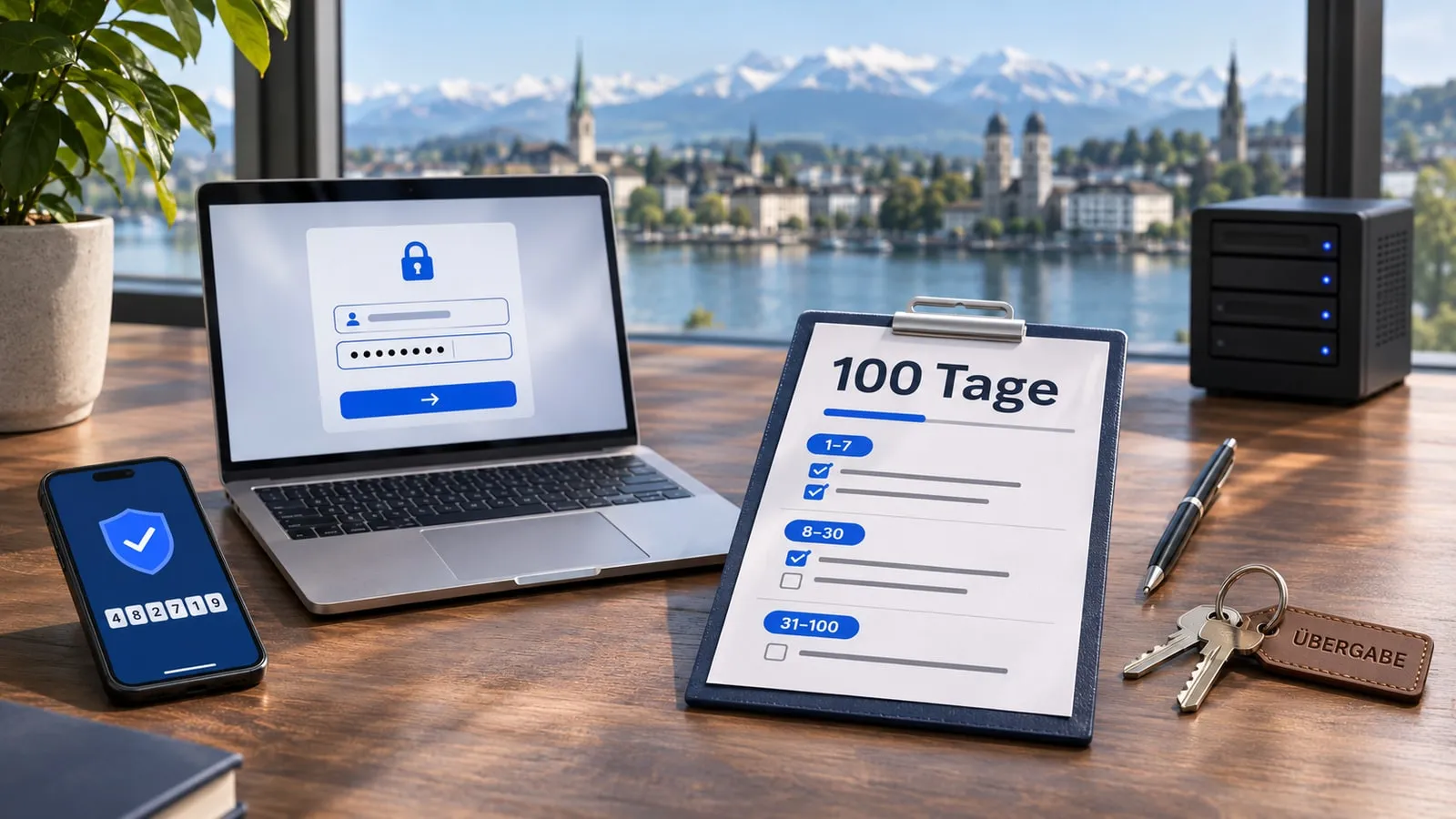
With the closing, the business acquisition is not finished; operationally, it is only just beginning. The first 100 days are about clean communication to employees, customers, suppliers and other key people. A planned transfer of knowledge, the orderly handover of customer relationships and a clear arrangement on what role the seller will still play in the transition phase are particularly important. In many Swiss SMEs, a great deal of implicit knowledge is tied to individual people. If this knowledge is not handed over systematically, friction, uncertainty and operational risks arise. Buyers should therefore prepare a simple handover plan even before the contract is concluded. The first months often decide whether a good transaction also becomes a good start.
Share deal or asset deal? What applies in Switzerland
In a business acquisition in Switzerland, the question arises sooner or later whether the takeover will be carried out as a share deal or as an asset deal. For buyers, this difference is important because it significantly changes the risks, effort and contractual logic.
In a share deal, the acquirer buys the shares of an AG or the quotas of a GmbH (limited liability company). The company itself continues to exist. Contracts, customer relationships, employees, permits and ongoing processes remain, in principle, in the same legal entity. For buyers, this is often more practical because the operational transition appears leaner. At the same time, however, you take over not only the functioning business but also existing obligations, risks and possible legacy liabilities in the company. In Swiss SME successions in particular, the share deal is the most common case. Anyone examining a Swiss succession that involves buying a GmbH, for example, will usually be confronted with exactly this structure.
In an asset deal, by contrast, the buyer acquires individual assets or defined parts of the business, such as customer contracts, machinery, inventory, brands or know-how. The existing company remains with the seller. From the buyer’s perspective, this is interesting because risks can often be delimited more cleanly. You specifically take over what you really want to acquire. In return, implementation is usually more complex. Contracts have to be transferred individually in some cases, consents obtained, permits checked and employment relationships properly settled.
In Swiss practice, the choice is not only a question of convenience, but also of law, taxes and negotiating power. The Swiss Code of Obligations governs the contractual foundations, and in the case of defects or warranted characteristics, warranty and liability play a major role. It is also relevant that statutory warranty claims can, in principle, become time-barred; a period of two years is frequently used, with contractual provisions remaining decisive in the individual case.
For buyers, the following therefore applies: the share deal is often simpler to execute but carries more legacy risk. The asset deal offers more scope for delimitation but is administratively more demanding. Which structure makes more sense depends on the target company, the risks, the industry and the tax consequences for both sides. This question should be clarified early on together with fiduciaries, tax advisors and legal specialists, not just shortly before the draft contract.
Financing a business acquisition in Switzerland
Financing a business acquisition is one of the most common bottlenecks in the Swiss market. Many buyers focus first on suitable target companies and only then clarify the financing. In practice, the reverse usually makes sense: anyone who knows what can be financed searches in a more targeted way and negotiates more credibly.
When it comes to equity, capital providers in Switzerland often expect a substantial contribution from the buyer. As a rough guide, 20 to 30 percent of own funds is often realistic for small and medium-sized takeovers. In individual cases it can be less, if the target company is very stable or additional collateral is available. In other cases more is needed, for example with fluctuating results, high investment requirements or limited debt capacity.
When it comes to bank financing, Swiss banks typically look at four points: the historical earning power of the company, the future affordability of the financing, the quality of the business plan and the person of the buyer. So it is not only figures that are relevant, but also leadership experience, industry understanding and a plausible concept for the time after the takeover. Banks want to see that interest and repayments can realistically be paid from ongoing business. Collateral improves the starting position but does not replace a viable business model.
The seller loan (vendor loan) is very common in SME successions. Here, the buyer pays part of the purchase price to the seller not immediately but at a later date or in instalments. For buyers, this reduces the capital required at closing. For sellers, it is a signal of confidence in the future of the company; at the same time, they bear a default risk. In negotiations, the seller loan is often an important instrument when price and financing capacity do not yet quite match.
An earn-out works differently: part of the purchase price is tied to the achievement of defined targets after the takeover, for example revenue, EBITDA or customer retention. This can make sense when buyer and seller have different expectations of the future. At the same time, an earn-out harbours potential for conflict. Unclear key figures, later questions of interpretation or differing operational decisions can lead to disputes. Earn-outs should therefore only be agreed with clear rules.
In addition to banks, investors, family capital or search fund structures also come into question. With ETA models in particular, it is common for capital providers to back the search and the later purchase. In return, they require a say, reporting and sound governance.
In practice, clarifying the financing rarely takes just a few days. Depending on complexity, the state of the documentation and the financing structure, you should rather expect several weeks to a few months. Buyers who tackle this topic early do not only save time. They also come across as considerably more professional to sellers.
How long does a business acquisition take?
Many buyers underestimate the timeline. A business acquisition in Switzerland usually takes considerably longer than the initial contact would suggest. From the first search profile to closing, six to twelve months is often a realistic expectation for small and medium-sized SMEs. With discreet search mandates or more complex financing, the process can also take longer.
Time is needed not only for the search itself, but above all for the coordination between buyer, seller, advisors and financiers. Delays are frequently caused by incomplete documents, open financing questions, unclear price expectations or several interested buyers in parallel. Special tax or legal questions can also prolong the process.
The process can be accelerated above all through good preparation. A clear buyer profile, an early financing commitment, swift decision-making and cleanly structured documents help considerably. Anyone who starts well prepared not only gains time but also appears more reliable in the market.
What does a business acquisition cost?
Reducing the costs of a business acquisition to the purchase price alone is a common mistake. In practice, several additional cost blocks arise around the transaction that buyers should plan for from the outset.
These include, first of all, the costs of advice and transaction support. Anyone who searches in a structured way and negotiates professionally often works with specialised M&A advisors or succession experts. Added to this are the costs of due diligence, for example through fiduciaries, tax advisors or financial specialists. Depending on structure and risk profile, there are also expenses for the legal review of contracts and the drafting of the purchase agreement. Business Successor offers everything from a single source, which improves communication and quality but also increases the speed of the process.
Notary, commercial register, notarisations and, where applicable, further completion costs should not be forgotten. With financing, there are also interest, arrangement fees or collateral costs. And often the additional capital requirement only begins after the purchase: working capital, investments, IT adjustments, staff expansion or succession arrangements place an additional burden on liquidity in the start-up phase.
First-time buyers in particular understandably concentrate on the purchase price. More decisive, however, is the question of how much capital is needed in total for the acquisition, ancillary costs and the first months after the takeover. Anyone who does not draw up this overall view early on risks overstretching a fundamentally good opportunity for liquidity reasons.
Common mistakes in a business acquisition
Buying a company is never just a strategic decision, but always an operational project as well. This is exactly where many first-time buyers underestimate the effort. The most common stumbling blocks from practice are described in our article on the 7 biggest mistakes when acquiring a business.
Fit before perfection
The perfect company rarely exists. What matters more is the fit between buyer and target company. A company can be economically attractive and still not suit the buyer. For example because of culture, industry, leadership role or complexity.
Understand the figures, but do not view them in isolation
Revenue, EBITDA and margins are important, but they are not everything. Buyers should also pay attention to the following factors:
- Dependency on individual customers
- Key people in the team
- recurring revenues
- investment backlog
- quality of the processes
- digitalisation
- market position and competition
- the seller’s willingness to hand over
A company with solid figures can have operational risks that only become visible in day-to-day business. How the purchase price of an SME actually comes about is explained in our article How is the purchase price of an SME really calculated.
Assess the time required realistically
Buyers coming from employment in particular often underestimate how much energy the search for, review of and takeover of a company demands. The process needs structure, discipline and the ability to make decisions. Anyone who embarks on it should plan for sufficient time and mental capacity.
Maintain confidentiality
Many succession processes run discreetly. Sellers often do not want employees, customers or suppliers to learn of their intention to sell too early. Buyers must handle this confidentiality professionally. Integrity and discretion are key factors of trust in the Swiss SME market.
Short checklist for buyers
Anyone who wants to buy a business benefits from a simple but consistent structure. The following short checklist covers the most important points from the buyer’s perspective. You will find a detailed version with all six phases and a PDF download in the business acquisition checklist for Switzerland.
Before the search
- Define the buyer profile
- Set the target industry and region
- Clarify your own role in the company
- Determine the available equity
- Outline a rough financing framework
During the review
- Understand the business model
- Review earnings and margins
- Analyse the customer structure
- Identify owner dependency
- Assess investment requirements
Before the purchase
- Have the valuation checked for plausibility
- Secure a financing commitment
- Have due diligence carried out
- Have the purchase agreement reviewed
- Draw up a handover plan for the first 100 days
The acquisition process in eight steps
A structured acquisition process reduces risks and increases the probability of success. The following eight steps have proven themselves in the Swiss SME market:
Step 1: Define buyer profile and search criteria
Clarification of industry, region, company size, financial framework and your own role.
Step 2: Market approach and sourcing
Active search via networks, advisors, platforms and direct outreach. The best opportunities are often not publicly advertised.
Step 3: Initial assessment and preliminary review
Rough review of business model, earnings, market position and basic fit.
Step 4: Confidential documents and discussions
Review of further information, initial discussions with the seller, alignment of expectations.
Step 5: Secure financing
Clarification of the financing structure, obtaining commitments, determination of equity, debt and possible seller loans (vendor loans).
Step 6: Valuation and letter of intent
A well-founded business valuation, signing of a letter of intent (LOI) with exclusivity and framework conditions.
Step 7: Due diligence and contract negotiation
In-depth review in the areas of finance, tax, legal and commercial. In parallel, negotiation of the purchase agreement, warranties and transitional arrangements. The detailed process is shown in the article on due diligence in a business acquisition.
Step 8: Closing and handover
Signing of the contract, payment processing, communication to stakeholders, transfer of knowledge and a planned first 100 days.
Anyone who goes through these steps with discipline minimises surprises and signals professionalism to sellers, advisors and financiers.
Acquisition costs in CHF: what buyers should plan for
In addition to the purchase price, a business acquisition in Switzerland involves various ancillary costs. Realistic cost planning prevents liquidity bottlenecks:
- Advice and transaction support: CHF 15’000 to 80’000. Depending on complexity and scope of support. Comprehensive mandates with active sourcing tend to be at the upper end.
- Due diligence (fiduciary, tax, legal): CHF 10’000 to 50’000. Financial, tax, legal and commercial due diligence. Costs vary depending on company size and risk profile.
- Notary and commercial register: CHF 2’000 to 10’000. Notarisations, entries, fees. In some cases higher for share deals than for asset deals.
- Financing costs: 1 to 3 % of the loan volume. Arrangement fees, interest on bridge financing, collateral costs.
- Handover and integration: CHF 5’000 to 25’000. IT adjustments, trademark transfers, communication, possible advice for the first 100 days.
As a rule of thumb, buyers should expect ancillary costs of 3 to 8 percent of the purchase price, and tending to be more for smaller transactions, as fixed costs weigh more heavily. In addition, a post-close liquidity buffer for working capital and initial investments is advisable.
A realistic timeline for a business acquisition
A business acquisition in Switzerland takes time. Anyone who starts with unrealistic expectations quickly loses credibility or overlooks important details. The following time estimate is based on the typical SME market:
Phase 1 — Preparation and profile (2 to 4 weeks)
Definition of the buyer profile, clarification of financing capacity, setting of search criteria.
Phase 2 — Sourcing and initial contact (2 to 6 months)
Active search, initial contacts, preliminary reviews. This phase is often the most time-consuming, as suitable target companies are rarely available immediately.
Phase 3 — Review and negotiation (2 to 4 months)
In-depth analysis, clarification of financing, LOI, due diligence, contract negotiation.
Phase 4 — Closing and handover (4 to 8 weeks)
Conclusion of the contract, payment, communication, transfer of knowledge, start of integration.
Overall, six to twelve months should be expected from the first discussions to closing. With complex financing, several interested parties or incomplete documents, the process can also take longer. Good preparation, swift decisions and professional support speed up the process considerably.
Financing overview: options in the Swiss market
Financing is one of the central pillars of every business acquisition. In Switzerland, buyers have various instruments at their disposal that can be combined depending on the situation:
Equity (20 to 30 %)
The basis of every financing. Swiss banks and investors generally expect a substantial equity share. The more stable the target company, the more flexible the requirements can be.
Bank loan (50 to 70 %)
The backbone of most SME takeovers. Banks examine earning power, affordability, the business plan and the personal suitability of the buyer. Terms of 5 to 10 years are common.
Seller loan (vendor loan) (10 to 30 %)
The seller co-finances part of the purchase price. Reduces the buyer’s capital requirement and signals confidence in the future of the company.
Earn-out
Part of the purchase price is linked to future targets. Helps where price expectations differ, but requires clear rules.
Investors and search funds
External capital providers participate in the search and the purchase. Common in ETA models, but they require a say and structured reporting.
The optimal financing structure depends on company size, industry, earning power, the collateral situation and the buyer’s personal situation. Early clarification with banks and advisors is crucial. You will find all the building blocks with a concrete worked example in the article on financing a business acquisition.
Share deal vs asset deal: the most important differences
The choice between share deal and asset deal is one of the fundamental structural decisions in a business acquisition. Both variants have specific advantages and disadvantages:
Share deal
The buyer acquires the equity interests in the company (shares or GmbH quotas). The legal entity continues to exist; contracts, employees and permits automatically remain in the company. The advantage lies in the lean operational transition. The disadvantage: the buyer also takes over all legacy liabilities, obligations and potential risks of the company. In Switzerland, the share deal is the most common variant in SME successions. The particularities of purchasing a GmbH are described in the article Buying a GmbH in Switzerland.
Asset deal
The buyer acquires individual assets or parts of the business. The existing company remains with the seller. Advantage: clean delimitation of risks, targeted selection of the assets acquired. Disadvantage: higher administrative effort, individual contract transfers, consent requirements, re-establishment of employment relationships and permits.
The decision depends on legal, tax and operational factors. Buyers should clarify this question early on with fiduciaries, tax advisors and legal experts in order to avoid later surprises.
Frequently asked questions about buying a business in Switzerland
1. How much equity do I need for a business acquisition?
As a guide, 20 to 30 percent of the purchase price is realistic. Depending on the stability of the target company and the collateral situation, it can also be less or more. More on this in the article How much equity is required for a business acquisition.
2. How long does a typical acquisition process take?
From the first idea to closing, six to twelve months is usual. Complex financing or discreet search mandates can prolong the process.
3. What does a business acquisition cost besides the purchase price?
Ancillary costs are typically 3 to 8 percent of the purchase price. These include advice, due diligence, notary, commercial register and financing costs.
4. What is the difference between a share deal and an asset deal?
In a share deal, equity interests are acquired and the company continues to exist. In an asset deal, individual assets are purchased. Share deals are operationally simpler; asset deals offer better delimitation of risk.
5. Do I need an advisor for a business acquisition?
For first-time buyers, professional support is strongly recommended. Advisors help with the search, valuation, financing, due diligence and negotiation. What matters when choosing one is shown in our article on business succession advisory.
6. What is a seller loan (vendor loan)?
The seller co-finances part of the purchase price, which is repaid at a later date or in instalments. This reduces the buyer’s capital requirement and signals confidence.
7. What is due diligence?
An in-depth review of the target company in the areas of finance, tax, legal and commercial. It serves to identify risks and substantiate the purchase price. The complete process is described in the article on due diligence in a business acquisition.
8. What are the first 100 days after the purchase?
The critical phase after closing. It is about communication, transfer of knowledge, customer relationships and orderly integration. Well planned, they lay the foundation for long-term success.
Why Business Successor?
Business Successor specialises in supporting business acquisitions and successions in the Swiss SME market. Our team combines many years of experience in M&A, corporate management, financing and strategic advisory.
Operational expertise
We know the Swiss SME market from practice, not just from theory. Our advisors have themselves led companies, supported transactions and successfully implemented succession processes.
End-to-end support
From defining the goals and the active search through to due diligence, negotiation and handover, we support buyers through the entire process. Everything from a single source, without breaks between systems or contacts. You will find an overview of our services on the Services page.
Network and market access
Through our network of fiduciaries, industry experts, financing partners and sellers, we open up opportunities that are not publicly available. Our succession platform brings together vetted offers and search mandates.
Focus on fit
We do not believe in quick deals, but in lasting fits. Our aim is to connect buyers with companies that are successful in the long term.
Anyone who wants to buy a business in Switzerland benefits from structured, professional support. Business Successor offers exactly that, with the aim of turning a good transaction into a good start as well. You will find the complete framework on business succession in Switzerland on our main page. Arrange a no-obligation initial consultation now.