A business acquisition consists of dozens of individual decisions spread over six to twelve months. Most of them are not complicated. Things only become difficult when they are taken in the wrong order, for example when financing is clarified after the letter of intent (LOI) or the handover is only planned after closing.
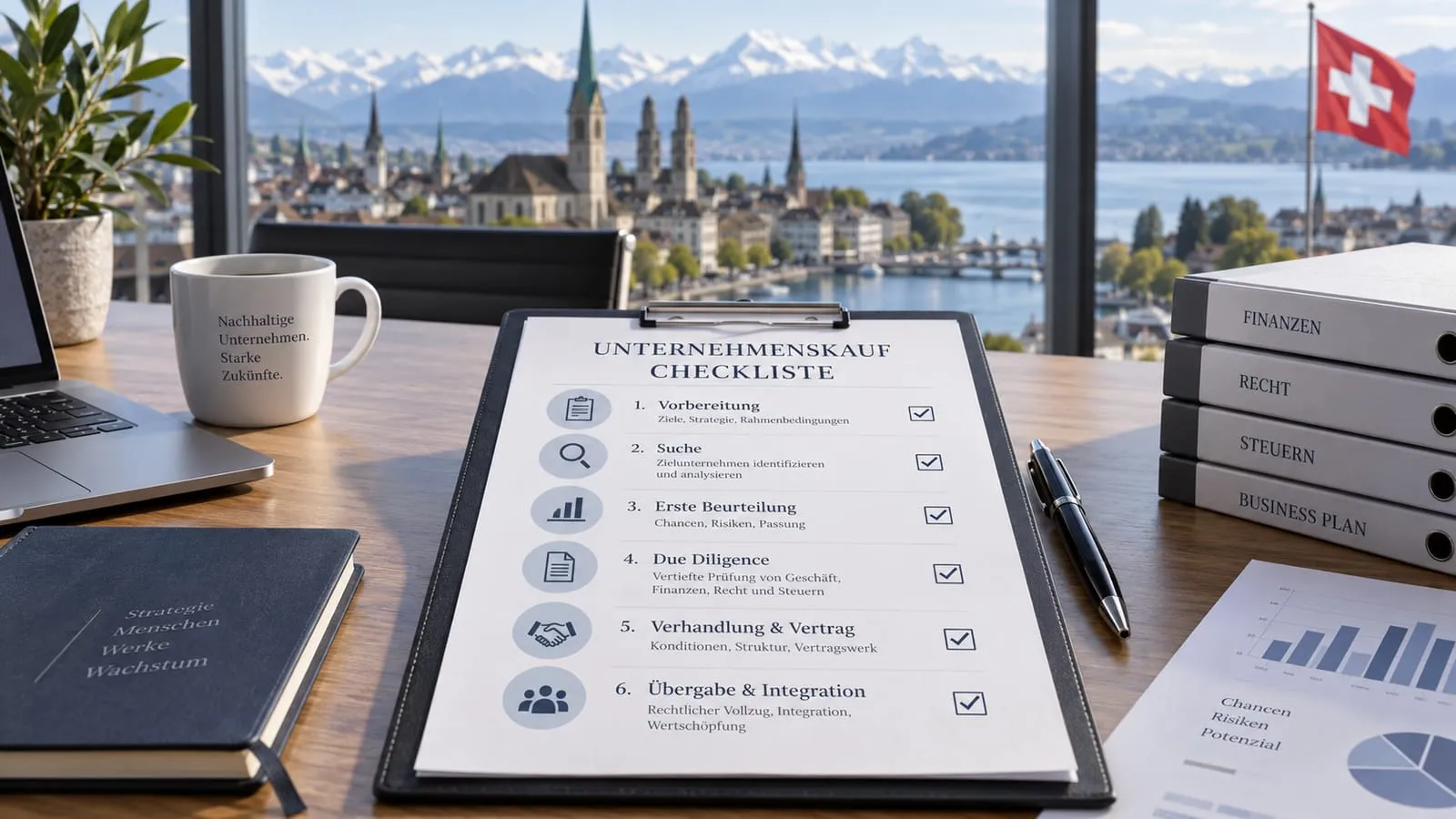
This checklist organises the acquisition process into six phases and states for each phase what must be completed before the next one begins. It is written consistently from the buyer’s perspective and tailored to the Swiss SME market. It does not replace professional advice, but it gives you a framework with which you keep the overview and appear well prepared in front of sellers, banks and advisers.
The checklist is also available as a PDF download, so that you can print it out and tick it off point by point.
Download the checklist (PDF, in German)
How to use the checklist
The six phases build on one another. Anyone who skips a phase usually has to catch up on it later at a higher cost. Not every point is equally important in every transaction: a service business with five employees does not need a machinery inventory, whereas a manufacturing business certainly does. Strike out what does not fit, but make that decision consciously.
For the in-depth review in phase 4, there is a separate, detailed checklist in the article Due diligence in a business acquisition. Here it is condensed to the essential points.
Phase 1: Preparation
Preparation determines the quality of all later steps. If you define clearly at this stage what you are looking for and what you can afford, you save months in the search.
- Clarify your motivation: operational management, investment or strategic add-on acquisition?
- Define your own role: managing director, board of directors, involvement in day-to-day business?
- Narrow down industry, region and company size (revenue, employees)
- Honestly assess your personal prerequisites: leadership experience, industry knowledge, available time
- Quantify your available equity, including reserves for ancillary costs and the first months
- Outline a rough financing framework: what can realistically be financed with 20 to 30 per cent equity?
- Hold an initial conversation with your main bank or a financing adviser
- Involve your family and personal environment, particularly regarding liability and time commitment
- Sketch out your team of advisers: fiduciary, tax, legal, transaction support
- Summarise your search profile on one page so that you can pass it on to intermediaries and your network
Phase 2: Search
Good Swiss SMEs are often brokered discreetly and not widely advertised. Anyone who searches only on platforms sees just part of the market. The search therefore requires several channels and staying power, typically two to six months.
- Set out your acquisition criteria in writing: revenue, earnings, number of employees, location, customer structure, investment needs, reason for succession
- Define exclusion criteria so that unsuitable offers can be sorted out quickly
- Monitor succession platforms and directories systematically
- Inform fiduciaries, banks and industry associations about your search profile
- Activate your personal network: former employers, suppliers, customers, fellow students
- Approach M&A intermediaries and succession advisers and consider a search mandate
- Prepare direct outreach to target companies, particularly where owners are over 60
- Ensure confidentiality: have a non-disclosure agreement (NDA) ready, do not name target companies to third parties
- Keep an overview of all contacts and rejections in order to recognise patterns
- Review your search profile after three months and adjust it if necessary
Phase 3: Initial assessment
As soon as a specific company is on the table, the task is a quick but honest rough review. The aim is not a complete analysis, but the decision as to whether the effort of an in-depth review is worthwhile.
- Request the sales documentation and initial figures (three sets of annual financial statements)
- Understand the business model: how does the company make money, and will that remain the case?
- Assess owner dependency: which tasks depend on the seller alone?
- Check customer concentration: share of revenue of the three largest customers
- Identify the second management level and key people
- Recognise an investment backlog: age of machinery, IT, vehicles, premises
- Question the reason for succession: age, health, market problems, conflicts?
- Compare the seller’s price expectation with an initial rough valuation
- Hold an initial conversation with the seller and align expectations regarding handover and role
- Discuss the feasibility of financing with the bank on the basis of the initial figures
- Document the decision: proceed, put on hold or decline
Phase 4: Due diligence
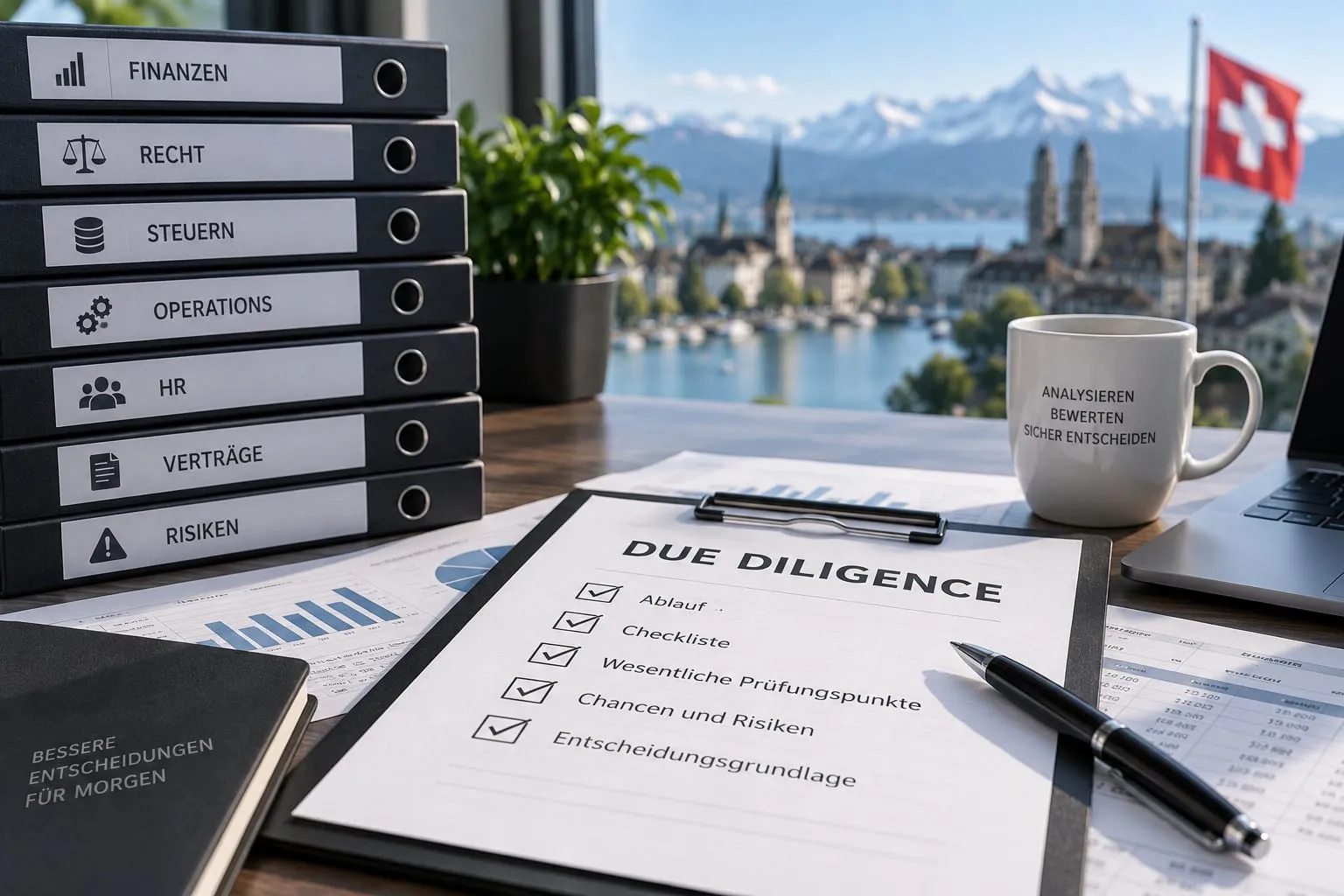
Due diligence turns interest into a sound purchase decision. It usually follows a letter of intent (LOI) and, for SMEs, takes from a few weeks to several months. Its findings flow directly into the purchase price, warranties and contractual terms.
- Sign a letter of intent with price range, exclusivity and timetable
- Define the depth of review and the team of advisers: fiduciary, tax, legal, an industry expert if required
- Send the document request list to the seller and have a data room set up
- Financial due diligence: sustainability of profit, normalisation of owner’s salary and one-off effects, cash flow, working capital, hidden liabilities
- Tax due diligence: open tax assessments, value added tax, social security, hidden profit distributions
- Legal due diligence: corporate structure, contracts with change-of-control clauses, employment contracts, permits, pending proceedings
- Commercial due diligence: customer contracts, repeat purchase rates, market development, competition, supplier dependencies
- Operational due diligence: processes, IT, deputising arrangements, documentation, know-how in people’s heads
- Staff and culture: key people, mood, openness to the change
- Collect red flags and divide them into three categories: deal-breaker, price-relevant, can be covered contractually
- Clarify the structure: share deal or asset deal, with tax consequences for both sides
- Have the valuation checked for plausibility on the basis of the adjusted figures
Phase 5: Negotiation and contract
With the findings of the due diligence, the actual negotiation begins. It is not only about the price, but about the allocation of risks between buyer and seller. Much of what came to light during the review can be solved contractually if it is clearly named.
- Secure binding financing: bank commitment, own funds, any seller loan (vendor loan), investors
- Negotiate the purchase price and payment terms: payment at closing, holdback, instalments, earn-out
- Define the seller’s warranties and representations, particularly regarding annual financial statements, taxes, contracts and legal disputes
- Agree indemnities for known risks from the due diligence
- Regulate a non-compete and non-solicitation obligation for the seller
- Define the seller’s role and remuneration during the transition phase
- Define the conditions for closing: regulatory approvals, consents from contractual partners, bank financing
- Have the purchase agreement reviewed by a legal adviser before it is signed
- Prepare the commercial register and notarial steps: amendments to the articles of association, signatory powers, change of shareholders
- Ensure insurance cover from closing: public liability insurance, property insurance, occupational pension scheme
- Coordinate the communication plan for employees, customers and suppliers with the seller
Phase 6: Handover and integration
Closing is the start, not the end. The first 100 days decide whether customers, employees and suppliers trust the new owner. A simple handover plan agreed in advance prevents most friction.
- Inform employees personally on the day of closing, core message: continuity
- Visit key customers and important suppliers together with the seller in the first two weeks
- Structure the knowledge transfer: who hands over what, by when, in what form?
- Switch over access rights, powers of attorney, bank mandates and signatory powers
- Adapt the commercial register entry, insurance policies, contracts and permits to the new owner
- Monitor liquidity weekly in the first months
- Retain key people: hold conversations, clarify roles and prospects
- No major changes in the first 100 days, unless they are imperative
- Define milestones for the first 100 days and align them with the seller
- Take stock after 100 days: what is working, what is not, which assumptions from the due diligence have been confirmed?
The most common gaps in practice
The same patterns emerge again and again from succession processes in the Swiss SME market. Three of them are particularly expensive:
- Financing is only clarified after the letter of intent. If the bank then says no, exclusivity is lost and the seller is unsettled.
- The handover is not regulated contractually. Without a defined role, duration and remuneration, the seller either withdraws too early or keeps having a say for too long.
- Red flags from the due diligence are negotiated as a price reduction but not covered contractually. A holdback or an indemnity protects better than a blanket discount.
Frequently asked questions about the business acquisition checklist
How long does it take to work through all the points?
From the search profile to closing, you should expect six to twelve months for Swiss SMEs. The search in phase 2 is usually the longest stage.
Do I need an adviser for every point?
No. Buyers can largely manage phases 1 to 3 themselves. For due diligence, contract and tax structure, fiduciary, tax and legal advice is almost always necessary.
Does the checklist also apply to the purchase of a GmbH or AG?
Yes. The phases are independent of the legal form. What needs to be considered specifically when buying a GmbH is shown in the article Buying a GmbH in Switzerland.
Can I download the checklist?
Yes, the checklist is available as a PDF download, with all six phases to tick off.
Conclusion: sequence beats speed
A business acquisition rarely succeeds because someone was particularly fast. It succeeds because the right questions were asked at the right time: financing before the letter of intent, due diligence before the contract, handover plan before closing. This checklist gives you the sequence. The answers you have to find for your target company yourself, or with support.
Business Successor supports buyers in all six phases, from defining the search profile to the handover. Download the checklist as a PDF or arrange a non-binding initial consultation via our contact page.