In Switzerland, financing decides the fate of a business acquisition more often than the purchase price does. Buyers find a suitable company, hold good discussions, sign a letter of intent (LOI) and only then discover that the bank cannot support the structure. By then the exclusivity period has been used up, the seller is unsettled and the process is back to square one.
If you clarify the financing early, you search in a more targeted way and negotiate more credibly. This article shows which building blocks make up acquisition financing in the Swiss SME market, what banks actually examine, which instruments reduce the equity requirement and what financing for a purchase price of CHF 1.5 million can look like in concrete terms.
The basic question: can the company pay for its own acquisition?
In an SME acquisition, the purchase price is almost never paid out of the buyer’s own assets. It is paid out of what the company earns after the acquisition. The central question of every acquisition financing is therefore: is the ongoing cash flow sufficient to cover interest and repayments, and is there enough money left over for investments, taxes and unexpected events?
This question is answered not by the purchase price but by the adjusted profit. Adjusted means: the owner’s salary is set at market level, private expenses are stripped out, one-off effects are eliminated and the investment requirement is taken into account. Only this figure shows how much debt service a company can really bear. How this adjustment works is described in the article on business valuation in Switzerland.
Building block 1: equity
Equity is the foundation. As a guideline, 20 to 30 per cent of the purchase price is required. With very stable earnings, a good collateral position or a substantial seller loan (vendor loan), it can be less; with fluctuating results, a high investment requirement or strong dependence on the owner, banks ask for more.
Two points are often underestimated here. First, the percentage usually refers to the purchase price, not to the total capital requirement: ancillary costs of around 3 to 8 per cent and a liquidity reserve for the first few months often come on top; the bank frequently co-finances part of this, but as a rule a share of your own funds is still needed. Second, not all assets count to the same extent as equity that the bank will recognise: mortgaged properties or current account limits available at short notice are weighted differently, and tied pension assets are in any case usually not available at all for a business acquisition. So clarify early with the bank which funds will actually be recognised.
Possible sources are savings, the sale of assets, loans from your private circle and participations by partners or investors. Early withdrawals from pension funds are possible only within narrow legal limits, as a rule only when taking up genuine self-employment, not when acquiring an existing AG (company limited by shares) or GmbH (limited liability company), and are therefore not available in the first place in most succession cases. Where they do come into question by way of exception, particular care is called for: whatever flows into a company is no longer available for your retirement provision. This decision should be discussed with a pension and tax adviser, not taken in passing.
Building block 2: bank financing
The bank loan carries the largest share, typically 50 to 70 per cent of the purchase price. In acquisition financing, Swiss banks essentially examine four things:
- Historical earning power. Three to five years of annual financial statements, adjusted. Banks are less interested in the best year than in the worst one and in the question of how stable the results are over a cycle.
- Affordability. Is the free cash flow sufficient to cover interest and repayments? As a rule of thumb, banks want to see a buffer: the available cash flow should exceed the annual debt service by at least around 20 per cent. If the cover is barely at one, the financing is considered too tight.
- The business plan. Not as a forecasting exercise, but as proof that the buyer has understood the business: where do the revenues come from, what risks exist, what happens in the first twelve months, and how will the dependence on the owner be resolved?
- The buyer as a person. Leadership experience, closeness to the industry, previous responsibility, creditworthiness. In a management buy-in, where the buyer comes from outside, this point weighs more heavily than in an internal takeover.
For a pure bank loan, the repayment period is usually four to seven years. Collateral is often scarce in service companies because there is hardly any substance that can be pledged. This is exactly where guarantees come in: through a guarantee cooperative, the repayment period can often be stretched to up to ten years thanks to the additional security.
Building block 3: guarantee cooperatives
If a company is economically viable but the buyer lacks collateral, a guarantee can close the gap. In Switzerland there are four guarantee cooperatives recognised by the Federal Department of Economic Affairs, Education and Research, which support capable SMEs in start-ups, investments and succession planning by standing surety with banks for loans of up to one million francs. The Confederation covers part of the administrative costs and, in the event of losses, bears up to 65 per cent of the default.
Four points are of practical relevance for buyers:
- The maximum guarantee amount is CHF 1 million, the term up to ten years. The guarantee decreases over the term in parallel with the repayment of the loan.
- The application goes through your principal bank, not directly. It makes sense to get in touch as soon as the bank considers the loan feasible in principle but collateral is lacking.
- A guarantee does not replace equity. The cooperatives expect the buyer to contribute substantial funds of their own; what is guaranteed is debt capital, not risk capital.
- The costs are manageable. At BG Mitte, there is an assessment fee of between CHF 300 and 2’000 depending on the amount of the guarantee, plus an annual risk premium of 1.25 per cent of the loan granted. BG OST-SÜD charges a premium of 1.0 per cent for guarantee amounts of up to CHF 500’000.
Particularly in succession planning in the trades, the guarantee is an established and often underestimated instrument. It costs less than most buyers expect, and it can make the difference between a rejection and an approval from the bank.
Building block 4: seller loan
With a seller loan, the seller defers part of the purchase price. The usual range is 10 to 30 per cent, repayable over three to seven years, mostly subordinated to the bank and interest-bearing.
The instrument works in three ways. It reduces the capital requirement at closing. It bridges differences in price expectations without the seller having to move away from the price in nominal terms. And it sends a strong signal to the bank: anyone who leaves part of the purchase price in the company believes in its future. Many banks therefore treat a seller loan partly like economic equity, provided it is subordinated and tied up for the term of the bank loan.
What needs to be settled is subordination, interest, the repayment schedule, collateral and the handling of warranty claims. A set-off clause makes sense: if a warranty case comes to light after the purchase, the buyer can set off the claim against the outstanding loan debt. In practice, this is more effective than any claim that would first have to be pursued in court.
Building block 5: earn-out
With an earn-out, part of the purchase price is linked to the achievement of defined targets after the acquisition, typically 10 to 20 per cent over two to three years. It helps when buyer and seller assess the future differently.
Earn-outs are, however, the most frequent source of disputes after closing. The seller has an interest in short-term results, the buyer invests in the future, and before long the bases of assessment are in dispute. Anyone who agrees an earn-out should therefore choose a clearly defined key figure that is hard to manipulate, record the calculation method and reference dates in writing, regulate the seller’s access to the figures and stipulate what applies in the event of structural changes in the company. Revenue is easier to verify as a measure than EBITDA, because with EBITDA every cost decision by the new management influences the result.
Building block 6: mezzanine capital and investors
Mezzanine capital sits between equity and debt: subordinated loans, profit-participating loans or convertible loans. It closes gaps when equity is lacking and the bank will go no further. The price for this is high, usually 8 to 12 per cent interest in the market, sometimes with an additional profit share. Mezzanine is therefore only worthwhile if the earning power can carry the costs and the structure remains limited in time.
In addition, investors, private equity firms and search fund structures come into consideration. They bring capital and often experience, but in return demand a say, reporting and orderly governance. For many buyers this is a change of culture: the entrepreneurial freedom you are seeking with the purchase is restricted again by an investor agreement.
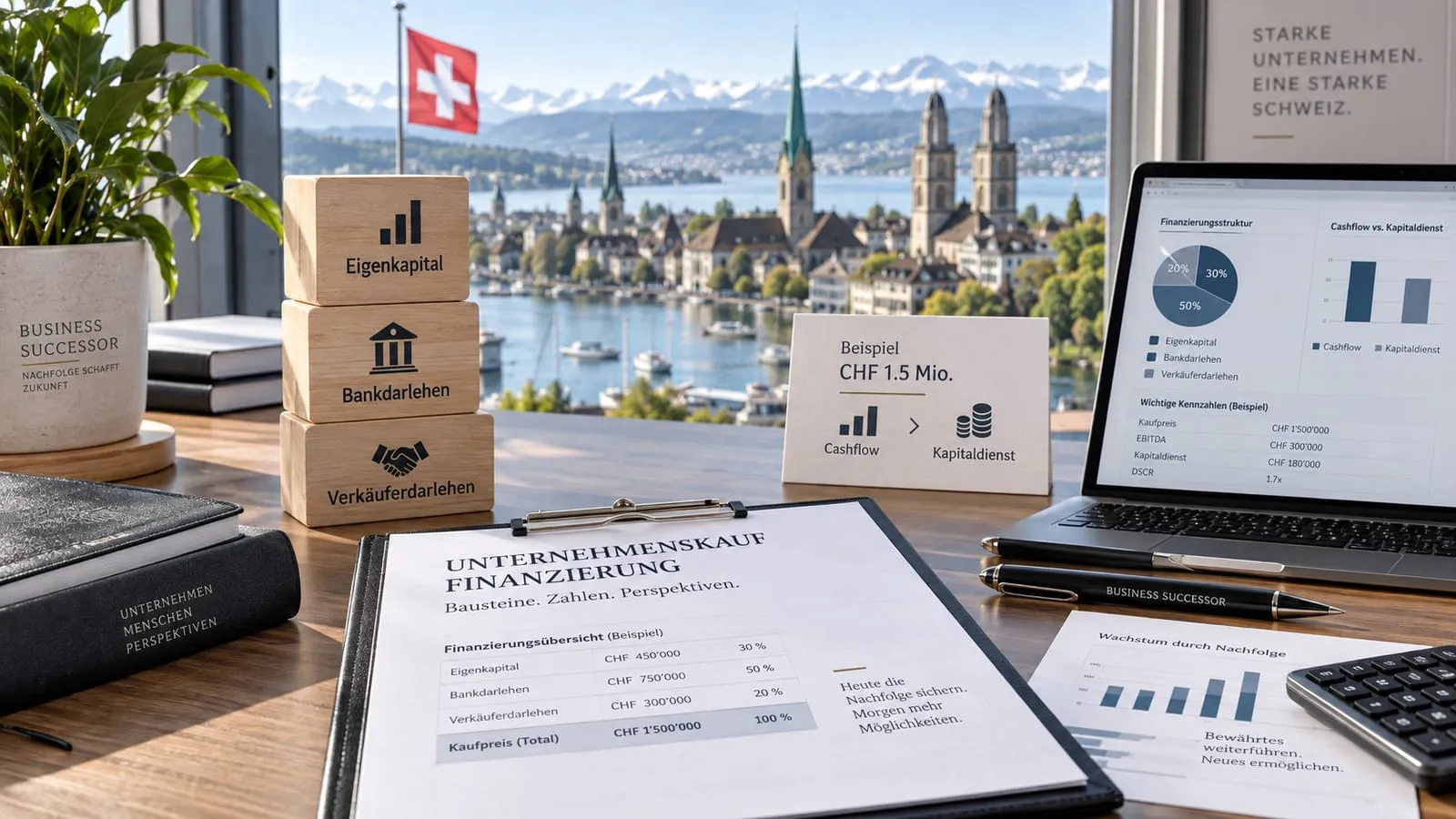
Worked example: purchase price of CHF 1.5 million
The following example is constructed, but corresponds to a typical constellation in the Swiss SME market. After adjustment, the target company generates EBITDA of CHF 400’000, with a market-rate managing director’s salary for the buyer. The purchase price is CHF 1’500’000.
On top of this comes the capital requirement beyond the purchase price: ancillary costs of around CHF 75’000 (5 per cent) and a liquidity reserve of CHF 50’000 for the first few months. The actual requirement for own funds is therefore around CHF 500’000 and not the CHF 375’000 that the percentage of the purchase price alone suggests. It is precisely this difference that causes financing to fail at the last moment.
| Financing building block | Amount CHF | Share |
|---|---|---|
| Equity | 500’000 | 33 % |
| Bank loan | 700’000 | 47 % |
| Seller loan | 375’000 | 25 % of the purchase price |
Affordability in the first year, at 4 per cent interest on the bank loan and 3 per cent on the seller loan: the annual debt service (interest and repayments together) is around CHF 220’000.
This is set against the available cash flow: EBITDA of CHF 400’000, less replacement investments of CHF 50’000 and taxes of around CHF 50’000, gives CHF 300’000. The cover is thus around 1.36 and lies above the guideline of 1.2 that banks want to see as a minimum.
This example makes two things visible. First: without the seller loan, the bank would have to finance CHF 1’125’000, the debt service would rise to around CHF 250’000 and the cover would fall to 1.2, exactly at the pain threshold. The seller loan here is not cosmetic, but the difference between financeable and tight. Second: repayments take up almost 60 per cent of the free cash flow. In the first few years, little room is left for growth investments. If you have bigger plans after the acquisition, you need to factor them into the financing from the outset.
The most common financing mistakes
- Started too late. Financing belongs before the letter of intent, not after it.
- Only calculated the purchase price. Ancillary costs and the liquidity reserve increase the requirement for own funds by a third or more.
- Bet everything on one bank. Two to three discussions in parallel provide benchmarks and prevent dependence.
- Did not raise the seller loan. Many sellers are open to it if the buyer justifies it objectively. If you do not ask, you will not get it.
- Calculated too tightly. Financing that only works in the planned scenario will not withstand the first bad quarter.
Conclusion: financing is part of the search, not its aftermath
If you know what can be financed, you search in the right order of magnitude, approach sellers credibly and do not lose exclusivity to a rejection from the bank. The building blocks are well known and combine well: equity as the foundation, a sustainable bank loan, a guarantee where collateral is lacking, a seller loan as a bridge and, where necessary, investors or mezzanine.
Business Successor supports buyers in clarifying the financing structure early, preparing discussions with banks and combining the building blocks in such a way that the acquisition still holds up in the third year. You will find an overview of the entire purchase process in the article Buying a business in Switzerland, and the complete step-by-step list in the Business acquisition checklist for Switzerland. For a concrete assessment of your situation, arrange a no-obligation initial consultation via our contact page.