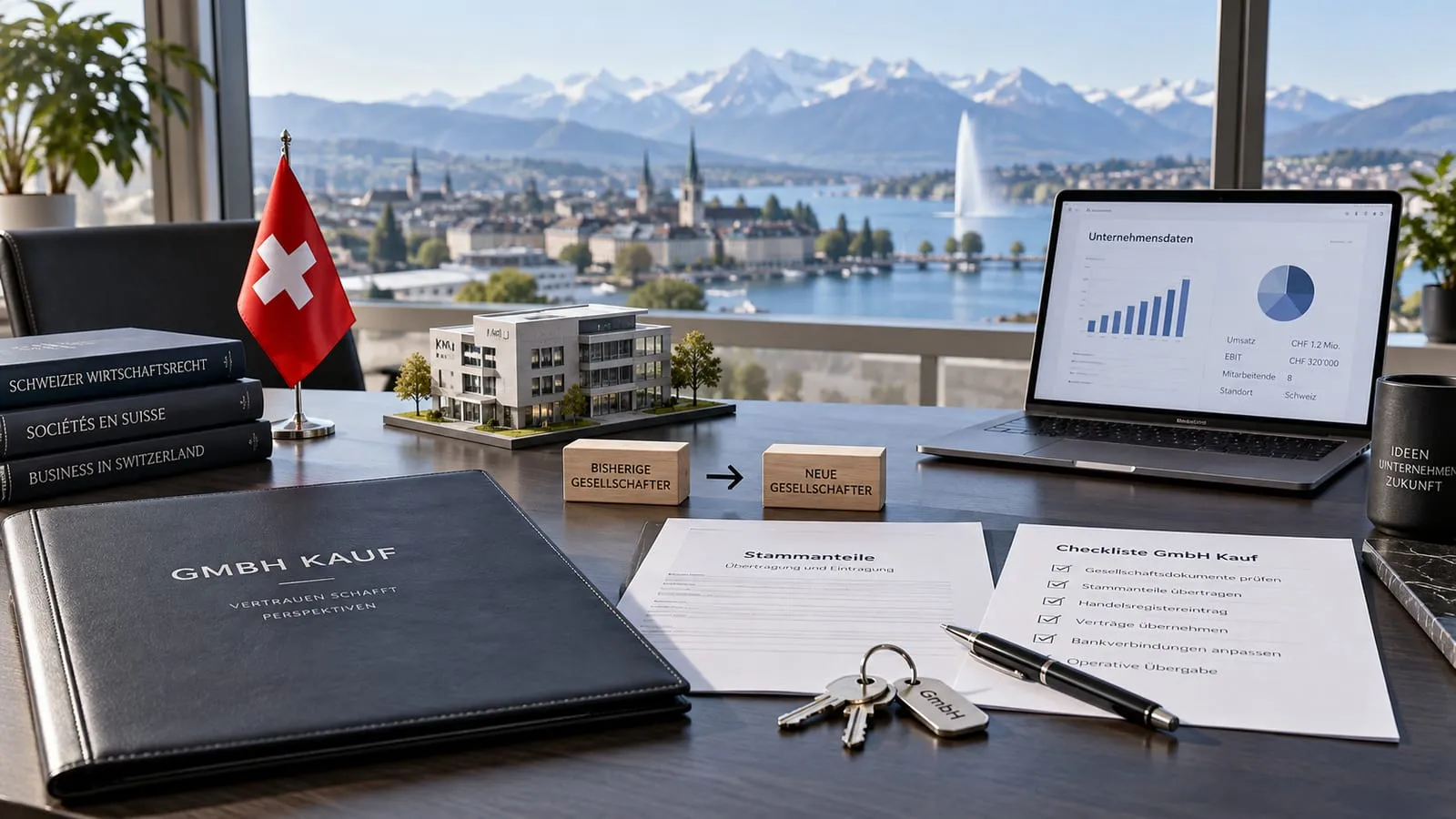
Buying a GmbH (limited liability company) is an attractive route into entrepreneurship for many buyers in Switzerland. Instead of founding a new company, they take over an existing one with a registered structure, ongoing business operations, customer relationships and, ideally, well-rehearsed processes. In the Swiss SME market in particular, buying a GmbH is therefore a practical alternative to founding a new company.
At the same time, acquiring a GmbH is more than just taking over a business concept. Buyers do not simply acquire revenue, customers and potential, but also a legal shell with rights, obligations, contracts, risks and tax implications. If you want to buy a Swiss GmbH, you should therefore not only assess the price but understand the company as a whole.
Business Successor supports buyers throughout the entire process, from the search for suitable opportunities through to structured review and implementation. You will find the full framework on business succession in Switzerland on our main page.
Why buy a GmbH instead of founding a new one?
For many buyers, founding a company is initially the obvious route. In practice, however, buying an existing GmbH can be considerably more efficient. If you take over a GmbH, you do not start from zero but build on existing structures.
The most important advantages include:
- existing customers and ongoing revenue
- well-rehearsed processes
- existing employees and know-how
- established market presence
- existing supplier and contractual relationships
- permits or operational foundations already in place
In Switzerland in particular, where many SMEs will be looking for a succession solution in the coming years, this creates interesting acquisition opportunities. The GmbH is a widespread legal form for small and medium-sized enterprises in Switzerland. The number of potential target companies in the succession market is correspondingly large.
What does buying a GmbH mean in legal terms?
If you buy a GmbH, you generally do not just take over individual assets but the company itself. From a legal perspective, the difference between two forms of transaction is important here.
Share deal
In a share deal, the buyers acquire the quotas (Stammanteile) of the GmbH. The company continues to exist legally; only the ownership changes. In practice, this is often the typical case when buying a Swiss GmbH.
Consequences of a share deal:
- contracts generally remain with the GmbH
- employees remain employed by the same employer
- the rights and obligations of the GmbH remain in place
- known and unknown risks also remain in the company
For buyers, that means: they take on not only opportunities but potentially also legacy liabilities.
Asset deal
In an asset deal, it is not the quotas that are taken over but selected assets, such as customer relationships, inventory, trademarks, machinery or individual contracts. The original GmbH remains with the seller.
Consequences of an asset deal:
- more targeted selection of the assets to be taken over
- risks can in part be delimited more effectively
- transfers are often more laborious because individual elements have to be dealt with separately
- contracts, permits or employees may have to be transferred individually
Which structure makes sense depends heavily on the starting position. In a classic succession process, the share deal is often the obvious solution.
Which legal points are particularly important when buying a GmbH
Review of the quotas
In a GmbH, the quotas are at the centre. Buyers should check in particular:
- Who is currently entered in the commercial register as a shareholder?
- Are the quotas fully paid up?
- Are there transfer restrictions or consent requirements?
- Are there ancillary rights or special agreements among shareholders?
- Do the commercial register, the articles of association and the internal documentation match?
Articles of association and shareholders’ agreements
The articles of association and any shareholders’ agreements govern, among other things, the transferability of quotas, voting rights, pre-emption rights, consent requirements and special veto rights. Buyers should understand exactly whether there are restrictions that affect the acquisition or the later management.
Contracts and obligations
When a GmbH is bought, many contracts remain in place within the company. The items to review are leases, customer contracts, supplier contracts, leasing agreements, loans, guarantees, insurance policies, employment contracts and any pending legal disputes. Particularly important is the question of whether contracts contain change-of-control clauses.
Organisation and representation
Buyers should also understand how the GmbH is formally organised: who is the managing director? Are there sole or joint signing powers? Is the company correctly entered in the commercial register? A formally sound company is not just an administrative detail but a factor of trust.
Due diligence: why it is indispensable when buying a GmbH
If you buy a GmbH, you should never rely on rapport or annual financial statements alone. Structured due diligence in a business acquisition is central to identifying opportunities, risks and possible deal breakers at an early stage. It is particularly important in a share deal, because the legal entity is taken over with its entire past.
When buying a Swiss GmbH, due diligence typically comprises: financial due diligence (income statements, liquidity, investment requirements), legal due diligence (articles of association, contracts, pending proceedings), tax due diligence (tax returns, VAT, deferred taxes) and operational due diligence (customer structure, key people, processes).
Tax points when buying a GmbH in Switzerland
Direct taxes
The GmbH remains liable to tax as a legal entity. In a share deal, the buyer takes over the company with its previous tax history. The points to clarify are open assessments, tax arrears, latent risks and correct documentation. Improper bookkeeping entries from the past can lead to additional tax claims later on.
Value added tax
VAT is a classic risk area. Buyers should check whether the company is correctly registered, whether revenue has been classified correctly and whether there are potential additional charges. In the services sector or with mixed revenue in particular, a more in-depth review is worthwhile.
Hidden risks in the company
In smaller owner-managed GmbHs, private and business matters are not always cleanly separated. This can be relevant for tax purposes in the case of private expenses run through the company, inappropriate salary structures, loans to shareholders or services between related parties that are not at arm’s length.
Structural questions
Depending on the transaction structure, further tax questions may become relevant, for example in the case of financing or restructuring in connection with the purchase. It is not only the existing tax position that matters, but also the question of how the purchase is structured.
Purchase agreement and protecting the buyer
When acquiring a GmbH, the purchase agreement is one of the most important instruments for limiting risk. Even good due diligence does not uncover everything. Important points are the object of purchase and the purchase price, payment terms, the time of handover, the seller’s warranties, indemnities for known risks, arrangements for problems discovered subsequently, non-compete clauses and support during the transition phase. In a share deal in particular, representations and warranties are decisive in protecting buyers against legacy liabilities.
Shell company or operating company?
When buying a GmbH in Switzerland, one distinction is central: there are pure shell companies and operating companies. A shell company has no or only minimal business operations, no significant customer relationships and usually no employees. It was often founded in order to take up a business later, or has remained as an empty shell after an earlier business was given up.
For buyers, a shell can be of interest in individual cases, for instance when an existing legal personality with a commercial register entry and a bank account is intended to enable a quick start. In practice, two points usually speak against it: first, Swiss tax law treats the sale of an economically liquidated shell as so-called shell company trading (Mantelhandel), which for tax purposes counts as a liquidation followed by a new foundation. Any tax loss carryforwards are lost, and issuance stamp duty may be payable. Second, a shell brings no market position with it, but it does bring a past that still has to be reviewed. If you only need a legal form, founding a new company is often cheaper and less risky.
In most cases, buyers are therefore looking for an operating company with ongoing business, existing customers and established processes. It brings revenue and structure with it, but also contracts, employees, historical obligations and potential legacy liabilities. Buyers should clarify early on which type of company they are looking for and which risks they are prepared to take on.
Capital increase after the purchase
After buying a GmbH, a capital increase may be necessary or sensible. Typical reasons are strengthening the equity base in dealings with banks, contributing funds for investment and growth, or bringing in further partners.
In Switzerland, the shareholders’ meeting resolves on the capital increase. The resolution and the associated amendment to the articles of association must be publicly notarised, followed by the application to the commercial register. New capital contributions can be made in cash or as a contribution in kind, provided the statutory requirements are met. The nominal capital of a GmbH is at least CHF 20’000.
Important for buyers: under Art. 781 of the Swiss Code of Obligations (CO), existing shareholders in principle have a subscription right to the new quotas, which can only be restricted for good cause. If you are the sole shareholder after the purchase, you have a free hand here; with several shareholders, the capital increase needs to be coordinated in advance. Clarifying matters early with your fiduciary and legal advisers is therefore advisable.
Commercial register: which steps are necessary when buying a GmbH
Unlike in an AG, the shareholders of a GmbH are entered in the commercial register with their name, place of residence and number of quotas. A change of ownership must therefore be filed. The procedure in a share deal typically looks like this:
- Assignment agreement for the quotas in written form (Art. 785 CO). Public notarisation is not required for this.
- Consent of the shareholders’ meeting to the assignment (Art. 786 CO). This consent is the statutory default; it is only dispensed with if the articles of association expressly waive it.
- Entry of the buyer in the company’s register of quotas.
- Application to the commercial register with certified signatures: new shareholder and, where applicable, new managing director and new signing authority.
Only amendments to the articles of association and changes to the nominal capital have to be publicly notarised. The mere change of shareholder and the change of management can be done with certified signatures. The commercial register fees are moderate, and processing generally takes a few weeks.
Costs and timeline when buying a GmbH
In addition to the purchase price, there are ancillary costs that buyers should plan for early on. Experience shows that they amount to 3 to 8 per cent of the purchase price, and tend to be higher for smaller transactions. The most important blocks:
- Advice, transaction support and due diligence by fiduciary, tax and legal advisers: the largest item, heavily dependent on the size and risk profile of the company
- Notary and commercial register: CHF 2’000 to 10’000, depending on whether amendments to the articles of association or a capital increase have to be notarised
- Financing costs: 1 to 3 per cent of the loan volume
- Capital requirement after closing: working capital, investments, IT and any personnel measures
You will find a detailed breakdown of the cost blocks with ranges in CHF in the article Buying a business in Switzerland.
As for the timeline, it is worth distinguishing between two phases: the entire process from the search profile to closing usually takes six to twelve months for SME acquisitions. The actual execution from the signed letter of intent (LOI) onwards, that is due diligence, contract negotiation and commercial register, is possible in four to eight weeks for a well-prepared share deal transaction. With extensive due diligence, negotiations over warranties or complex financing, three to six months is more realistic.
First steps for buyers of a Swiss GmbH
Our article on buying a business in Switzerland describes the structured entry into the purchase process in detail. In brief:
- Define the search profile: clarify industry, size, region and role
- Clarify your financial options: check own funds and financeability
- Identify target companies: through networks, platforms or direct outreach
- Carry out an initial assessment: check the strategic, operational and economic fit
- Plan the due diligence: structure the legal, tax, financial and operational review
- Negotiate the transaction professionally: settle purchase price, warranties, structure and handover
Conclusion: Buying a GmbH in Switzerland with a professional review
Buying a GmbH is an attractive route into entrepreneurial responsibility for many people in Switzerland. At the same time, acquiring an existing company involves legal, tax and operational questions that must be examined carefully.
Particularly important is the understanding that buying a GmbH usually means taking over a legal entity together with its history. That is precisely why well-founded due diligence, a sound contract structure and the right tax classification are so decisive.
Business Successor supports buyers in identifying suitable companies, recognising risks at an early stage and structuring the purchase process professionally. If you would like to buy a GmbH in Switzerland, you will find the way in on our page on business succession in Switzerland or directly in a no-obligation initial consultation.