Due diligence is the moment when interest turns into a sound purchase decision. Before that, much sounds plausible: the company is established, the figures look good, the owner seems reputable. As a buyer, however, you need to know more than what is said in a first conversation or written in a sales document.
A well-thought-out process ensures that you do not merely examine a company superficially, but answer the questions that decide the purchase: Are the figures correct? Where do the risks lie? Is the purchase price justified? Which warranties belong in the contract? And how realistic is the handover?
This guide is written consistently from the buyer’s perspective and gives you a practical structure for a business acquisition in Switzerland.
What does due diligence mean in a business acquisition?
Due diligence essentially means a careful examination. In a business acquisition, this means systematically scrutinising a target company before the takeover: are the statements, figures and assumptions from the preliminary discussions correct, and which risks must be reflected in the purchase agreement?
The point is not to collect reasons against the purchase. It is a decision-making tool. In the end, you should know whether you want to buy, at what price, under what conditions and with what handover plan.
When does due diligence begin?
The in-depth review usually starts after the first discussions, a rough valuation and often after a non-binding declaration of intent, the letter of intent (LOI). Before that, there is already a preliminary review: does the company fit the buyer profile? Are size, industry, region and price range realistic?
In SME successions in particular, this preliminary review pays off. Many businesses appear interesting until it turns out that they depend heavily on the owner or do not fit what the buyer can finance. Our main page on business succession in Switzerland offers a complete overview of how to get started with the search for a company.
Due diligence process: the most important steps
1. Define the objective and depth of review
Not every due diligence has to go equally deep. A small service provider is examined differently from a manufacturing business with machinery and several locations. Clarify at the outset which questions really count for your purchase decision: How stable are revenue and margin? Which contracts are material? How present is the owner in day-to-day business? Are there open legal, tax or personnel issues?
2. Request and organise documents
Determine which documents you need. In professional processes, this is handled via a data room. In smaller SMEs, the documentation is often incomplete. That is not a reason for exclusion, but it must be put into context. Missing documents show exactly where you should ask more detailed questions. Organise everything by topic: finance, tax, legal, personnel, customers, suppliers, operations, IT and insurance.
3. Financial due diligence
The financial review is usually at the centre. The items to be examined are revenue development, gross margin, EBITDA, cash flow, receivables, payables, inventory, investment needs, owner’s salary, leasing, loans and hidden liabilities. The central question: will the reported profit remain realistic after the change of ownership?
A concrete example: a business reports stable profits, but the owner works 60 hours a week and pays himself a low salary. After the takeover, an additional manager may be needed, and the sustainable profit is already lower than initially thought. How these adjustments affect the purchase price is shown in the article on business valuation in Switzerland.
4. Tax and legal due diligence
The legal review shows which obligations you take over as well: corporate structure, material contracts, lease and employment contracts, loans, pending disputes and permits. In addition, there are tax issues such as value added tax, profit taxes, social security and the tax consequences of the transaction structure. Whether a share deal or an asset deal makes more sense should be clarified with specialists. Specifically when buying a GmbH in Switzerland, additional particularities apply concerning capital contributions (Stammanteile) and the commercial register.
5. Commercial due diligence
The focus here is on market, customers and competition. Examine customer structure, contract terms, repeat purchase rates, sales channels, pipeline and market development. With SMEs, there is one further decisive question: do the customer relationships depend on individuals? If important customers stay mainly because of the previous owner, the handover deserves particular attention.
6. Operational due diligence
The operational review answers whether the business also runs without the previous owner. This includes processes, organisation, employees, IT systems, machinery, inventory and documentation. In many Swiss SMEs, a great deal of knowledge is not in manuals but in people’s heads. That increases the handover risk considerably.
7. HR and cultural due diligence
This part is often underestimated. A business acquisition is not just a transaction, but a change of responsibility. Pay attention to the soft factors: How does the previous owner lead? How open is the team to change? How strongly does the culture depend on the founder? These questions often decide whether the purchase really holds up after closing. In a management buy-in, this point weighs particularly heavily, as the buyer comes from outside.
The most important areas of review at a glance
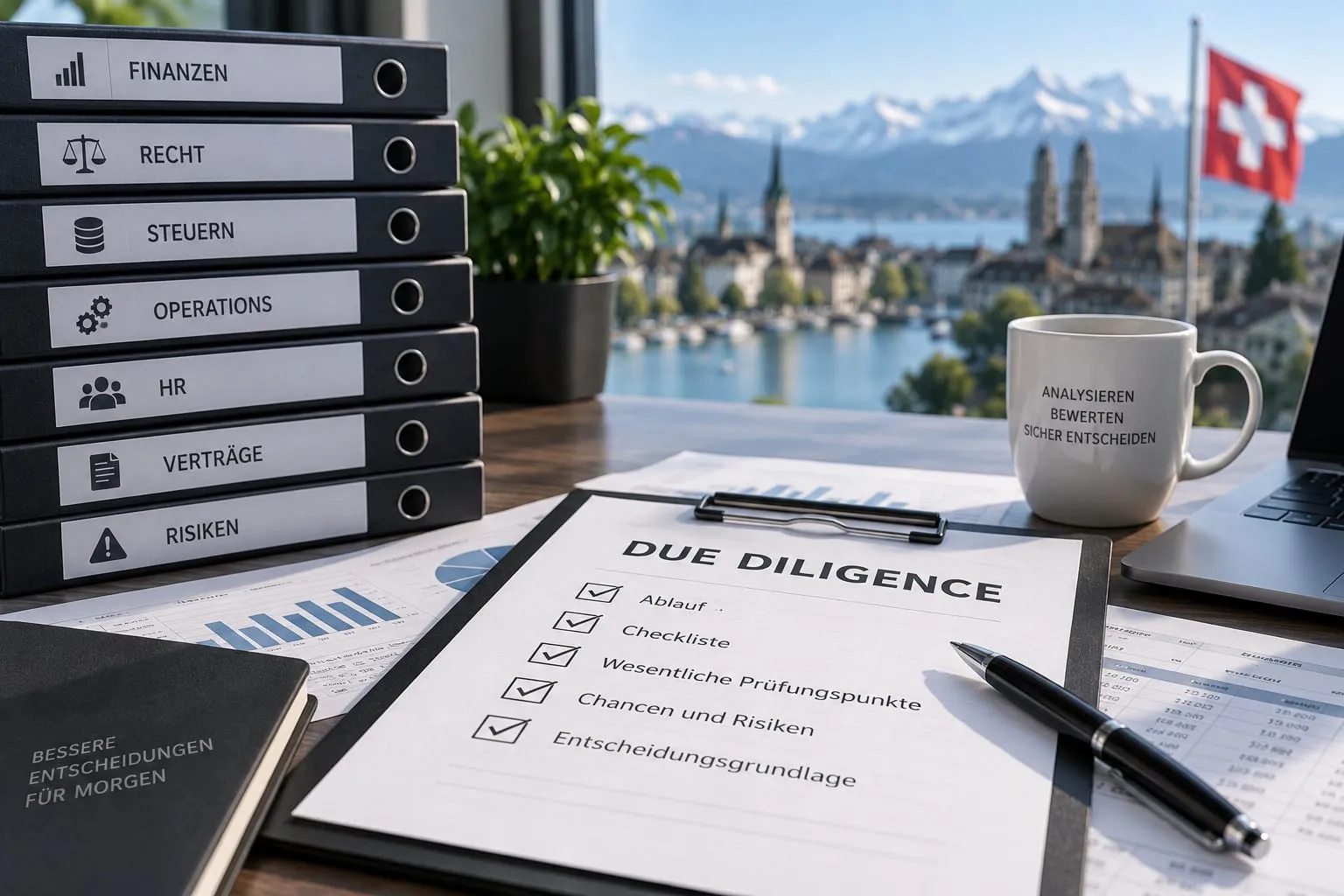
Finance, tax, legal, customers and market, personnel, operations and handover — these are the seven areas that come onto the table in every due diligence.
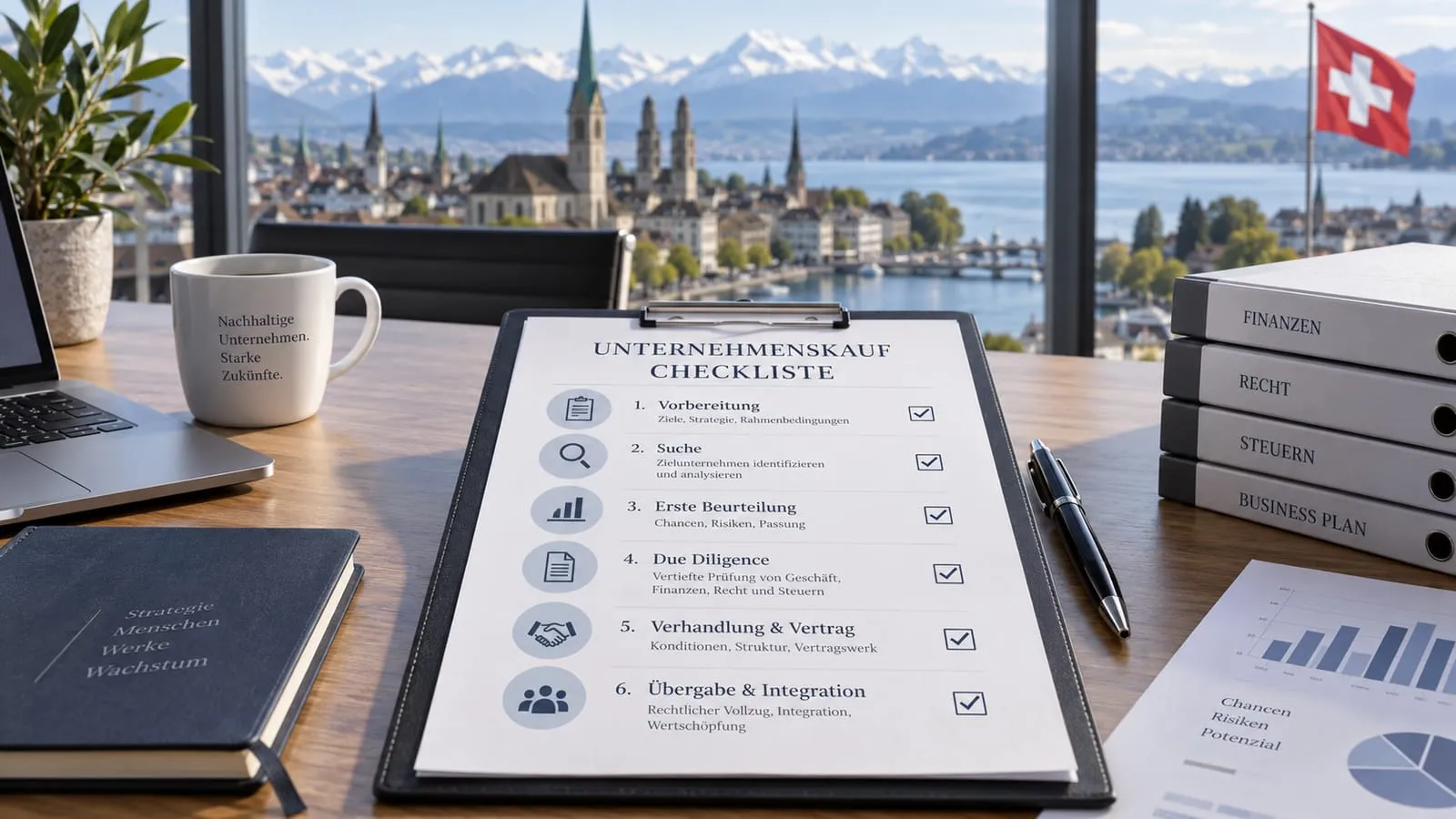
You will find a complete, practical checklist with all review points to tick off — including a PDF download — in our article business acquisition checklist for Switzerland.
Typical red flags in due diligence
- A large part of revenue depends on one or two customers
- The owner is irreplaceable for sales, customer care, technology and leadership
- Material contracts exist only verbally or are barely documented
- Profit is strongly shaped by one-off effects
- Investment needs are pending that are missing from the valuation
- Employees with key knowledge are neither retained nor involved
- The seller evades critical questions or delivers documents very late
- Tax or legal points are unresolved
How long does due diligence take?
For smaller SMEs, a focused review can take a few weeks. For more complex companies, it takes considerably longer. What matters is less the duration than the quality of the preparation. If documents are complete and important questions are defined early, the process runs noticeably more efficiently. If new issues constantly arise, it quickly becomes longer.
What happens after due diligence?
In the end, there is rarely a clear-cut yes or no. Usually, there are concrete consequences for purchase price, contractual terms or handover: the purchase price is adjusted, part of it is held back, the seller stays on board for a transition phase, or warranties are worded more precisely in the contract. Because the findings flow directly into negotiation and contract, experienced support is particularly valuable at this point. More on this in the article on business succession advisory.
How Business Successor supports buyers
Business Successor supports buyers in conducting due diligence not as a mere collection of documents, but as a decision-making process: defining the areas of review, putting documents into context, working with specialists from finance, law and tax, and translating the findings into concrete negotiating points. In Swiss SME successions, this interplay is particularly important, because very few risks are black or white.
Conclusion: due diligence determines the quality of the purchase
A business acquisition does not become good because the first discussions are pleasant. It becomes good when assumptions are tested, risks are understood and open points are clearly negotiated. A well-thought-out process gives buyers certainty without losing them in details.
If you want to buy a Swiss SME and set up the review professionally, start with our overview of business succession in Switzerland, use our business acquisition checklist for Switzerland as a practical guide, or arrange an appointment for a non-binding initial consultation directly.