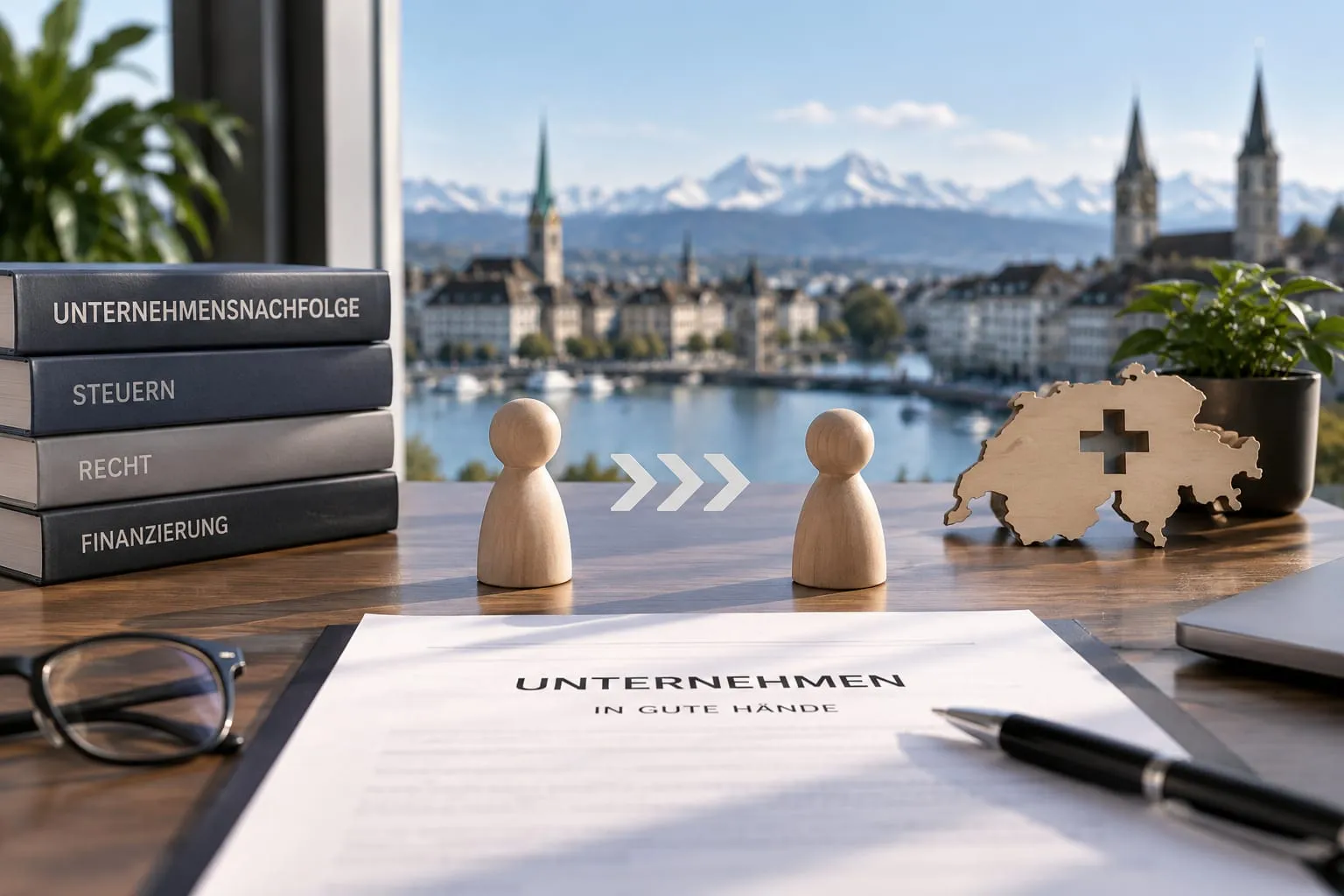
Succession planning is one of the central challenges of the Swiss SME market. By 2030, thousands of companies will face the task of finding a viable solution for the transfer or sale. For sellers, this often means an emotional and strategic turning point. For buyers, a concrete opportunity opens up at the same time: taking over an existing, functioning company instead of starting from zero.
Anyone who assesses a succession from the buyer’s perspective, however, is not entering a simple market environment. Not every succession situation is cleanly prepared, not every company is ready to be taken over and not every seller has realistic ideas about value and process. That is exactly why a structured approach is decisive. You will find the complete framework for business succession in Switzerland on our main page.
Why succession situations are attractive for buyers
The basic idea is simple: buy a business instead of founding one. Anyone who takes over an existing company does not start with an idea, but with a functioning base. Existing customers, well-established processes, qualified employees and an established business model considerably shorten the path into entrepreneurial responsibility.
In Switzerland in particular, this perspective is currently especially relevant. Many owners are reaching retirement age, family successions are becoming rarer and the number of companies seeking an external solution is growing. For buyers, whether as a sole entrepreneur, ETA candidate, prospective management buy-in buyer or investor, this creates a market with real substance.
The prerequisite, however, is that buyers understand a succession situation not only as an opportunity, but also as a complex process. Because between an attractive offer and a successful takeover lie numerous steps of review, negotiation and structuring.
1. Assess the company’s readiness for succession
Not every company that is for sale is actually ready to be taken over. A central question for buyers is therefore: is the company structurally in a condition that allows a successful takeover?
Buyers should examine in particular: Is the company heavily dependent on the current owner? Are customer relationships institutionalised or tied to individuals? Are processes documented and able to function without the owner? Is the bookkeeping kept properly? Are contracts, permits and legal foundations in order?
Owner-managed SMEs in particular are often closely intertwined with the person of the owner. That does not necessarily mean that a purchase makes no sense, but it influences the risk assessment, the length of the transition and frequently also the purchase price. Buyers should recognise these dependencies early and include them in their considerations.
2. Economic substance instead of superficial key figures
Many buyers are guided by revenue, profit or a multiple customary in the industry. These figures are relevant, but on their own they are not sufficient. A well-founded assessment requires a deeper look at the economic substance.
Important questions are: How sustainable are the earnings? How heavily does the company depend on individual customers or suppliers? Is there an investment backlog? How is the market developing? Are provisions and liabilities correctly recorded? Are there extraordinary or non-recurring effects that distort the result?
A clean analysis prevents buyers from overvaluing a company on the basis of incomplete or embellished figures. As part of due diligence in a business acquisition, these points are examined systematically and form the basis for a well-founded purchase decision.
3. Legal and tax diligence
In Swiss successions, legal and tax issues are often underestimated. Particularly when buying a GmbH in Switzerland or an AG, the buyer takes over the legal entity with its entire history, including potential risks.
Buyers should pay attention to the following: Are quotas (Stammanteile) or shares correctly documented and transferable? Do the articles of association or shareholders’ agreements contain transfer restrictions or consent requirements? Are there contracts with change-of-control clauses? Are there pending legal disputes or undiscovered obligations? Have tax returns and value added tax been declared properly?
The transaction structure itself also has tax consequences, for example in the choice between share deal and asset deal, in financing structures or in any restructurings. Involving specialist experts at an early stage is not a formality here, but a genuine risk factor.
4. Realistic price expectation and financing
The purchase price is one of the most frequent sources of misunderstanding. Sellers often have emotional expectations that are guided by their life’s work. Buyers tend to think in terms of future earning power and risk. A realistic business valuation in Switzerland that brings together different perspectives is therefore central.
Just as important is the question of financing. Anyone who only clarifies late in the process how own funds, debt capital, earn-out models or any investors interact loses time and negotiating power. Buyers should build their financing structure early and test it realistically.
5. Actively shape transition and integration
A succession does not end with the signing of the contract. It is precisely in the first months after the takeover that it is decided whether the transaction will be economically successful. Buyers often underestimate how much effort integration, the stabilisation of customer relationships and the building of trust among employees require.
What matters: a clear transition arrangement with the previous owner, transparent communication with the team, a binding approach to customers, realistic operational planning for the first months and a clean integration of existing processes.
Anyone who actively shapes the transition phase protects not only the substance of the company, but also the basis for their own further development. In succession solutions in particular, the transition is often the most critical part of the entire process.
6. Avoid typical mistakes
In successions in particular, similar mistakes occur again and again. The most frequent include: insufficient due diligence, being guided too strongly by emotions instead of substance, underestimated owner dependency, financing clarified too late, a lack of integration after closing and an unclear allocation of roles during the transition phase.
Anyone who knows these risks can address and manage them early. This is exactly where the value of professional support lies: not in taking over responsibility, but in creating structure, transparency and confidence in decision-making. More on this in the article on business succession advisory.
Conclusion: succession planning in Switzerland from the buyer’s perspective
For buyers, succession is one of the most attractive forms of entrepreneurship. Anyone who takes over an existing company builds on substance and does not start from zero. The prerequisite, however, is a clear understanding that a succession situation is complex, individual and fraught with risk.
Buyers should structure readiness for succession, economic substance, legal and tax diligence, transition and financing from the very beginning. Anyone who takes these points seriously avoids typical mistakes and creates the basis for a successful takeover.
Business Successor supports buyers along this path, from identifying suitable succession companies through professional review to implementation. You will find more on the overall topic on our page on business succession in Switzerland, or arrange a non-binding initial consultation directly.